

Team building activities work best when they are treated as part of how a company builds trust, not as a break from “real work”. Done well, they improve morale, strengthen communication, help people recover from stress and create the conditions for better staff performance. The strongest results come from choosing activities that match your team’s needs, culture and working style - not from forcing everyone into the same generic event.
For leaders, HR teams and managers, the real value is practical: better collaboration, fewer misunderstandings, stronger employee engagement and a workplace where people feel more willing to contribute.
Team building activities improve corporate culture by giving employees shared experiences that build trust, psychological safety and connection across roles or departments. When people know each other beyond task lists and meeting agendas, they are more likely to communicate openly, ask for help earlier and approach conflict with curiosity instead of defensiveness.
Culture is shaped by repeated behaviours. A single afternoon activity will not transform a disconnected workplace but regular, thoughtful experiences can reinforce the values a company wants to see every day: inclusion, respect, accountability, wellbeing and teamwork. This is why the benefits of team building activities are strongest when they are connected to clear business and people goals.
Gallup’s employee engagement research links highly engaged teams with stronger performance outcomes, including profitability, productivity, retention-related measures, wellbeing and absenteeism. Its 2024 Q12 meta-analysis reviewed data from more than 180,000 teams, showing why engagement should be treated as a business issue rather than a “nice to have”.
The most effective morale boosting activities do more than entertain people for an hour. They create moments where employees feel seen, supported and connected to the group. That matters because morale affects how people show up: whether they contribute ideas, stay resilient during busy periods and believe their work environment is worth investing in.
Employee engagement benefits also extend beyond mood. Engaged employees are more likely to understand expectations, feel connected to purpose and collaborate productively with others. Team building supports those outcomes by improving the human systems behind performance: trust, communication, energy and shared commitment.
The practical takeaway is simple: staff performance improves when people have the relationships and confidence to do good work together. Team building is not a substitute for strong leadership, fair workloads or clear strategy but it can make those foundations easier to sustain.
Trust is one of the most important links between culture and performance. A team that trusts each other can move faster because people do not waste as much energy second-guessing motives, hiding mistakes or protecting territory. They can raise concerns earlier, challenge ideas respectfully and adapt when priorities change.
This is especially important in hybrid and remote teams, where casual connection is less likely to happen naturally. Without deliberate effort, employees may only interact when something is urgent, unclear or stressful. Over time, that can make relationships feel transactional.
Team building creates intentional space for human connection. A short virtual lunch, a team reflection session, a wellness day or a problem-solving challenge can all help people understand each other’s communication styles. When those experiences are repeated, they become part of the team’s operating rhythm rather than a one-off event.
The best team building activities are the ones that solve a real team need. If morale is low, a restorative wellness activity may be more useful than a competitive challenge. If communication is breaking down, a facilitated discussion or listening exercise may be more effective than a social event.
A helpful way to choose is to match the activity type to the outcome you want:
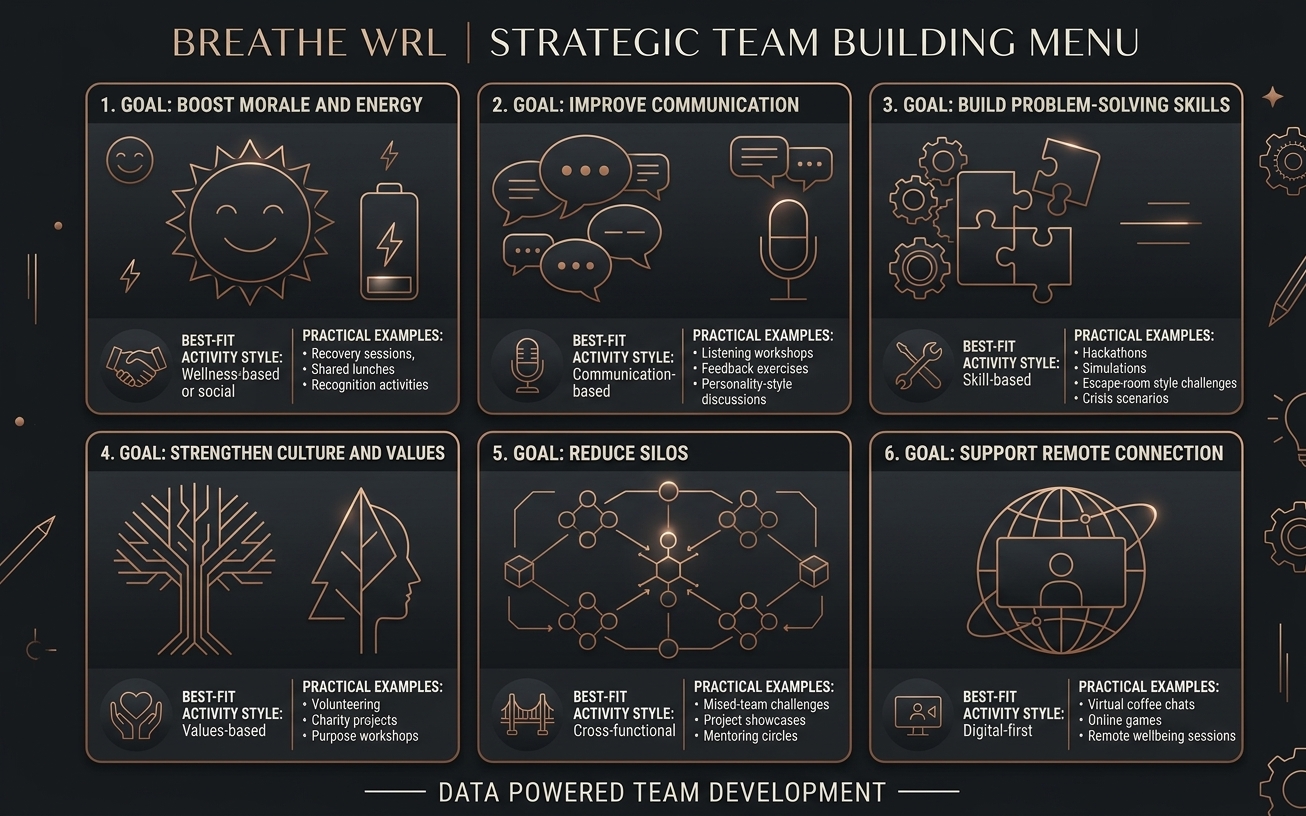
The key is not to chase novelty. It is to choose an activity that feels relevant, respectful and easy for people to participate in. A team of exhausted employees may not need another high-energy competition; they may need recovery, reflection and genuine appreciation.
Breathe WRL offers recovery and wellness services that can be shaped into a restorative team building experience, particularly for organisations that want to support wellbeing while bringing people together. Our services include red light therapy, full body cryotherapy, localised cryotherapy, private infrared sauna, float therapy, compression therapy and a deluxe cryo facial. We also offer a Group Wellness Day for groups of 10 or more, combining infrared sauna sessions, compression boots and cryotherapy in a format designed to help teams feel relaxed, recovered and refreshed.
This type of group experience is useful when the goal is to make team building feel restorative instead of forced. Infrared sauna sessions can create a calm setting for decompression, compression therapy supports blood flow and relief from discomfort and cryotherapy is positioned around recovery, pain relief and energy. For teams dealing with demanding workloads, that makes wellness-based team building a practical alternative to another meeting-room activity.
If your organisation wants morale boosting activities that feel meaningful, consider a Breathe WRL group booking for your next team building session. A group wellness format can give employees time to reset together while reinforcing a culture that values health, recovery and sustainable performance.
Poorly designed team building can backfire. Employees can become sceptical if an activity feels compulsory, awkward, poorly timed or disconnected from what they actually need. The difference between a useful initiative and a forgettable one is usually preparation.
Start by asking what the team is experiencing right now. Are people tired? Is there tension between departments? Are new employees struggling to connect? Are remote workers feeling invisible? The answer should guide the format, timing and tone.
Use this checklist before planning your next activity:
This approach keeps team building grounded. Employees are more likely to engage when they can see that the activity was chosen for them, not simply imposed on them.
The best culture-building efforts do not rely only on quarterly events. They show up in daily habits: how meetings are run, how wins are recognised, how managers check in and how teams recover after busy periods. Larger events can create momentum but smaller rituals keep that momentum alive.
For example, a team might start Monday meetings with a two-minute priority check, end Friday with peer recognition or create a monthly cross-team learning session. Remote teams can rotate facilitation, create informal chat spaces or schedule short wellbeing breaks that are genuinely optional. These small routines help employees build familiarity without adding heavy time commitments.
Wellness-focused activities can also be built into the rhythm of work. A company might book a group recovery session after a major project, plan a Breathe WRL Group Wellness Day as part of a leadership offsite event or use a wellness experience to support teams after a demanding quarter. The message is clear: performance matters and so does recovery.
Team building ROI should be measured through both hard and soft indicators. The goal is not to prove that one activity magically changed the company. The goal is to understand whether repeated investment is improving the conditions that support performance.
Useful measures include:
Leaders should also look for behavioural signs. Are employees speaking up more in meetings? Are teams resolving issues sooner? Are new starters forming connections faster? These observations help translate employee engagement benefits into practical workplace outcomes.
For a simple framework, measure three stages: before, during and after. Before the activity, identify the problem and baseline sentiment. During the activity, observe participation and energy. Afterward, collect feedback and connect any lessons back to daily work.

One common mistake is treating team building as a reward for surviving stress, rather than addressing the causes of stress. If employees are overloaded, a fun activity may be appreciated briefly but it will not fix unclear priorities or unrealistic workloads. Team building works best alongside good management practices.
Another mistake is choosing activities based on what leaders enjoy rather than what employees need. A physically intense challenge may energise some people and exclude others. A highly personal sharing exercise may feel powerful to one group and invasive to another. Inclusion should be designed in from the beginning.
Finally, avoid making team building a one-off event with no follow-up. If people raise issues during a workshop or feedback session, leaders need to respond. Otherwise, employees may learn that participation does not lead to change.
The benefits of team building activities are clearest when organisations use them to support real cultural goals: better trust, stronger communication, healthier conflict and more sustainable performance. Employees do not need gimmicks; they need experiences that help them feel connected, respected and ready to do good work together.
Whether your team needs a reset, a morale lift or a healthier way to reconnect, choose activities that match the moment. For organisations looking for wellness-led team building, Breathe WRL’s group offering provides a practical option built around recovery, relaxation and shared wellbeing. Consider making a group booking with Breathe WRL to give your team an experience that supports both culture and performance.


